The snake plant in your bedroom, the pothos on the shelf, the peace lily you've had since 2019 — if you chose them partly because they were supposed to clean your air, that’s guidance that came from a real study. Just not quite the one plant marketers have been selling you.
Here's a look at what NASA's Clean Air Study found back in 1989, and what a major 2019 peer-reviewed reanalysis concluded.
The NASA Clean Air Study
In 1989, NASA scientist B.C. Wolverton published "Interior Landscape Plants for Indoor Air Pollution Abatement," a study motivated by a very specific problem: sealed spacecraft accumulate volatile organic compounds (VOCs) i.e. chemicals off-gassed by equipment, materials, and human activity in a closed environment with no natural ventilation.
The study placed individual houseplants in sealed Plexiglas chambers, injected known concentrations of benzene, formaldehyde, and trichloroethylene, and measured how much of each compound the plant removed over roughly 24 hours. Results showed that many of the plants tested did measurably reduce VOC concentrations under those conditions.
What the study did not test: a real room with ventilation, typical household VOC concentrations, or anything resembling the conditions in an actual home. Also important to note is that the study was a cooperative effort between NASA and the Associated Landscape Contractors of America, a trade association for the houseplant and landscaping industry.
The 2019 Re-Analysis in Real Rooms
In 2019, Bryan Cummings and Michael Waring at Drexel University published a peer-reviewed reanalysis in the Journal of Exposure Science & Environmental Epidemiology titled, without much ambiguity, "Potted plants do not improve indoor air quality." They reviewed 196 experimental results from 12 published studies and translated them into a standard air-cleaning metric, clean air delivery rate (CADR), that allows direct comparison with other air-cleaning approaches.
Their finding: the median clean air delivery rate for a single potted plant was 0.023 m³/hour. To match the VOC removal rate that normal outdoor-to-indoor air exchange already provides in a typical building, you would need between 10 and 1,000 plants per square meter of floor space.
In an average 200-square-foot bedroom, meeting the lower end of that range would require 2,000 plants. A real home (even a well-sealed one) turns over its air volume roughly once per hour. Plants remove VOCs slowly, over hours or days in static conditions.
The Real Benefits of Plants
While indoor plants are not the best method of removing VOCs, they still provide several important benefits:
- Absorb CO₂ and release oxygen through photosynthesis. However, the scale is modest relative to the volume of a room
- Provide documented psychological and wellbeing benefits. Research consistently finds that indoor plants reduce stress and improve mood, even when air quality effects are negligible.
- Absorb some VOCs at the root zone. The mechanism NASA documented is real at the micro-scale though it does not scale to meaningful air quality improvement under typical conditions.
What plants don't do in a real home: meaningfully reduce the concentration of airborne chemicals, particles, pathogens, mold spores, or VOCs at any scale a normal household can achieve.
Some plants also introduce their own airborne compounds. Certain species release terpenes and other VOCs, and damp soil can be a source of mold spores, which is a consideration for households with asthma or mold sensitivities.
Tools That Improve Indoor Air Quality
The most effective method of improving indoor air quality is adequate ventilation. Opening windows when air quality is good outside is one of the simplest and most underutilized solutions.
Other tools that support indoor air quality:
- HEPA (high-efficiency particulate air) filtration: captures particles including dust, pollen, pet dander, and some virus-laden droplets if large enough. Misses viruses and bacteria carried on very small particles and does not inactivate what it captures.
- Activated carbon filters: specifically designed to adsorb VOCs and chemical gases.
- Source control: low-VOC paint, fragrance-free cleaners, no synthetic air fresheners, and zero-chemical disinfection options all help manage air quality at the source.
- Far-UVC light solutions: inactivate mold spores, as well as viruses and bacteria.
Controlling Mold, Viruses, and Bacteria
For households that care about improving indoor quality as naturally as possible, Far-UVC light addresses the mold and pathogen side of the problem. It works by damaging the DNA or RNA of viruses and bacteria in the air and on surfaces so they can no longer replicate, with a similar mechanism for mold making spore reproduction impossible. The 222nm wavelength of Far-UVC has been found in peer-reviewed research to be safe for continuous use in occupied spaces and emits no chemicals or toxins.
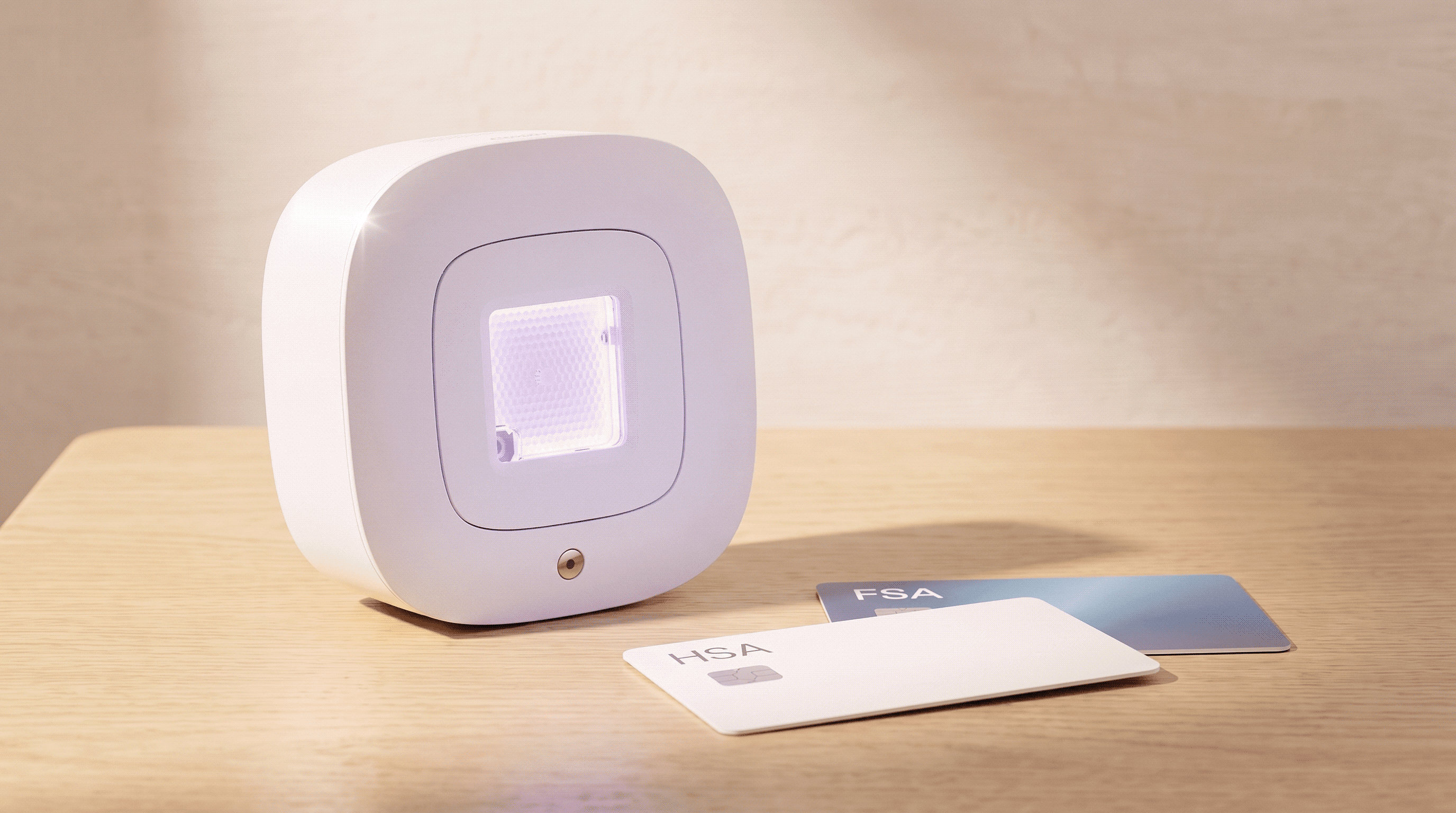
Beacon uses this technology — the same category that hospitals rely on, brought into the home in a form that mounts easily on the wall and runs without any action from you. Beacon is an EPA-registered disinfection device, shown in testing to inactivate up to 99.99% of airborne pathogens including the viruses that cause influenza, RSV, and COVID-19.