There's no single best way to disinfect your home. There's a best tool for each job, and most homes need more than one. Sprays and wipes handle surfaces. Air purifiers handle particles. Far-UVC light handles the air and surfaces continuously. Here's how each one actually works, where it falls short, and how to combine them.
What's the difference between cleaning and disinfecting?
The EPA draws a hard line between these words, and most product labels blur it on purpose. Cleaning removes dirt and organic matter using soap or detergent, but it doesn't kill anything. Sanitizing kills bacteria on surfaces, but isn't designed to kill viruses. Disinfecting kills both viruses and bacteria on surfaces using chemicals, and it's held to a higher testing bar than sanitizing.
Only products that make a disinfecting or sanitizing claim get EPA-registered as antimicrobial. A bottle labeled "cleaner" (even a nice-smelling one) isn't required to kill anything, and usually doesn't.
Do disinfectant sprays and wipes actually work?
Yes, when used correctly. EPA-registered disinfectants, found on the agency's List N, are tested against pathogens harder to kill than most seasonal viruses. The catch is contact time: a surface has to stay visibly wet for the full time listed on the label (often four minutes or longer), or the product doesn't do its job.
- Pros: cheap, EPA-registered, effective against a broad range of pathogens on hard surfaces.
- Cons: most people wipe and move on before contact time is met; many formulas contain VOCs, fragrances, and residues that irritate skin and airways; they only treat the surface you physically sprayed or wiped.
Can a HEPA air purifier disinfect a room?
It filters, but "disinfect" oversells it. HEPA filtration physically captures airborne particles, including viruses attached to respiratory droplets, as air passes through the unit, and lab tests show HEPA filters can capture over 99.97% of particles in a single pass.
Real-world results are murkier. A 2025 randomized trial across 200 elementary school classrooms found active HEPA purifiers were not associated with lower odds of high viral exposure compared to sham units, though they were tied to a modest, statistically significant reduction in the number of different virus types found in a room. Placement, room size, and air-exchange rate all matter more than the purifier's spec sheet.
- Pros: genuinely helps with allergens, dust, and smoke; no chemicals; passive and quiet.
- Cons: only works on air that reaches the filter; real-world viral reduction is inconsistent; does nothing for surfaces; filters need regular replacement to keep performing.
What about ozone generators and ionizers?
This is the category most homeowners don't know to be wary of. Ozone generators are marketed as air cleaners, but the EPA has found that under normal use they can produce ozone levels that exceed health standards — enough to cause chest pain, coughing, and airway irritation, with children and people with asthma most at risk. The agency states plainly that no ozone-generating device has been approved for use in occupied spaces.
- Pros: none that hold up under EPA scrutiny for occupied home use.
- Cons: produces a lung irritant as a byproduct of "cleaning" the air; not designed for rooms with people or pets in them.
Are UV-C robots and wands safe for home use?
Traditional germicidal UV-C light (254nm) is genuinely effective. Hospitals have used it for decades to disinfect surfaces and air. The problem is exposure: the FDA warns that direct skin and eye exposure to conventional 254nm UVC radiation can cause painful eye injury and burn-like skin reactions, and some consumer UV-C wands have been flagged for emitting unsafe radiation levels. That's why hospital UV-C robots only run in empty rooms, with motion sensors that shut them off if a person walks in.
- Pros: strong, well-established disinfection of surfaces and air.
- Cons: unsafe for rooms with people in them; only useful for the hours a room sits empty; some consumer devices have failed FDA safety checks entirely.
What is Far-UVC light, and how is it different?
Far-UVC is a narrower band of UV light — around 222nm, versus 254nm for traditional germicidal UV — and the wavelength difference changes everything about where it can be used. Far-UVC doesn't penetrate the outer layer of human skin or the tear layer of the eye the way 254nm light does, so it can safely run continuously in occupied spaces within established exposure limits, instead of only in empty rooms.
Independent lab research backs the underlying mechanism: low doses of 222nm far-UVC light — as little as 1.2 to 1.7 mJ/cm² — inactivated 99.9% of aerosolized human coronavirus in chamber testing. That's the trade Far-UVC makes: it can't be pointed at a single stubborn spot the way a spray can, but it works on the air and every exposed surface in the room, all day long.
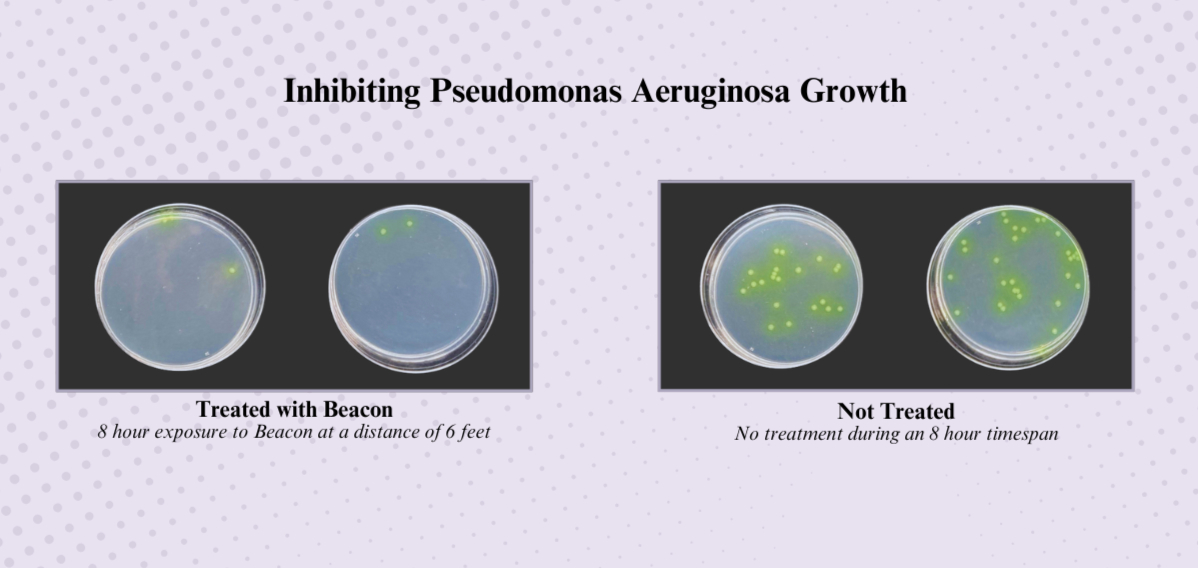
This is the gap Beacon is built to close: a device that treats the room itself 24/7, instead of asking you to remember contact time or filter changes.
- Pros: works safely and continuously in occupied spaces; treats both air and surfaces; no chemicals, toxins, or residue.
- Cons: line-of-sight only; can't reach inside drawers or behind furniture
What should you actually use to disinfect your home?
Most homes end up layering methods rather than picking one:
- Spray or wipe high-touch surfaces (doorknobs, counters, remotes) with an EPA-registered disinfectant, and let it stay wet for the full contact time on the label.
- Use a HEPA purifier for allergens and particulates, but don't rely on it alone to reduce viral spread.
- Consider Far-UVC for continuous, hands-off air and surface disinfection in rooms people actually use.
None of these tools has to work alone. Beacon's Far-UVC 222nm devices run continuously in occupied rooms, inactivating up to 99.99% of pathogens — including the influenza virus, RSV, and the virus that causes COVID-19 — in the air and on surfaces, all day.