Medically reviewed by Vidya Mony, DO, Pediatric Infectious Diseases; and Margit K. Chapman, RN
About 6.6% of U.S. adults are immunosuppressed — more than double what researchers believed just a few years ago, according to a University of Washington study published in JAMA. That's somewhere between 17 and 22 million people living with a body that responds to ordinary germs differently than most.
If you're managing this for yourself or someone in your household — rheumatoid arthritis, lupus, multiple sclerosis, COPD, active cancer treatment, a transplant, inflammatory bowel disease on biologics — you already know the calculus is different. A cold that knocks a healthy person out for a few days can mean a hospital stay, a delayed treatment cycle, or weeks of recovery for someone whose immune system can't mount the usual response.
This post covers what's actually happening in your home environment, why it matters more than most people realize, and what you can do about the part of it you control.
Why the home environment matters for immunocompromised people specifically
For most healthy people, the environment is a minor factor in getting sick. You touch a doorknob, you wash your hands, your immune system handles the rest without you noticing.
For immunocompromised people, environmental pathogens that pose negligible risk to healthy individuals can cause serious infection. Airborne fungal spores, bacteria, and viruses that many people never think about become real exposure risks.
Hospitals build entire ventilation systems, room pressure protocols, and air filtration standards around this fact for their highest-risk patients. Your living room doesn't have any of that, but the underlying biology — what's in the air, and what it means for someone whose immune system can't respond normally — doesn't change because you're at home instead of in a hospital.
The conditions where this matters most
If you or someone you care about is managing one of the following, the home environment is increasing risks more than you might realize:
- Rheumatoid arthritis and other conditions treated with biologic DMARDs (Humira, Enbrel, Rituxan, and similar) suppress immune signaling pathways as their mechanism of action, which is also why they carry FDA black box warnings for serious infection risk.
- Lupus involves both immune dysregulation from the disease itself and immunosuppression from corticosteroid treatment, a combination that compounds vulnerability to various infections.
- Multiple sclerosis patients on many disease-modifying therapies have measurably reduced immune response, and viral infections are a documented trigger for MS flares.
- COPD and pulmonary fibrosis don't suppress the immune system directly, but compromised lung tissue means a routine respiratory virus can escalate into something far more serious, far faster.
- Active cancer treatment — chemotherapy in particular — causes significant, often severe immunosuppression, sometimes to the point of neutropenia, where even common environmental organisms become dangerous (CDC's environmental infection control guidance specifically flags severely neutropenic patients as the highest-risk group for environmental pathogen exposure).
- Organ and stem cell transplant recipients require sustained immunosuppression to prevent rejection — by design, for the rest of their lives in many cases.
- IBD patients on biologics (TNF inhibitors, JAK inhibitors) face the same infection-risk tradeoff as RA patients on the same drug classes, for the same mechanistic reasons.
What about air purifiers?
Most households with an immune-impacted condition have a HEPA air purifier. HEPA filtration captures airborne particles, including many that carry viruses and bacteria.
However, HEPA filters capture particles; they don't inactivate what they capture. A virus or bacterium trapped on a filter can remain viable for hours or longer and is only eliminated from the environment when the filter is replaced.
For someone with a healthy immune system, this distinction matters less. For someone who's immunocompromised, it's the difference between a system that traps pathogens and one that reduces them in the air and on surfaces.
How Far-UVC 222nm light disinfects differently
Germicidal UV light isn't new. Hospitals, labs, and water treatment facilities have relied on it for decades to disinfect air and surfaces. The catch has always been that conventional germicidal UV (254nm) is harmful to skin and eyes, so it can only run in empty rooms, without people present.
Far-UVC at 222nm works by the same basic mechanism — damaging the DNA and RNA of viruses, bacteria, and mold spores so they can no longer replicate — but at a wavelength that does not penetrate human skin or the eye to a depth that causes harm. That means it can run continuously, in the room, while people and pets are present.
There are some air purifiers with built-in UVC; however, microbes are not exposed to the UVC light for long enough to effectively damage them. This is why standalone Far-UVC units are far more effective in reducing germ load in the room.
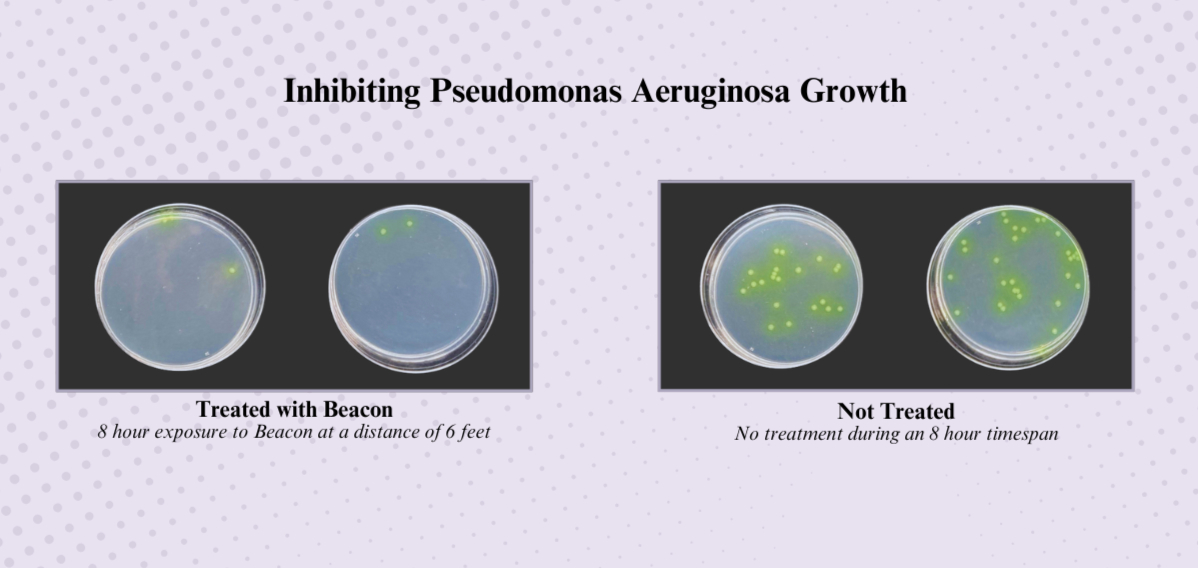
Beacon brings this technology (the same category of disinfection hospitals have trusted for years) safely into the home. Beacon is shown to inactivate up to 99.99% of airborne and surface pathogens including the ones that cause influenza A and B, RSV, and COVID-19, running quietly in the background with no chemicals, no residue, and no effort.